Showing posts with label addiction recovery. Show all posts

Friday, September 1, 2017

How does recoveryBox help me break my addiction?


Wondering what recoveryBox is and if it can help you? Well, do you have an addiction, habit, hurt or hang-up that you want to break? If so, then recoveryBox is your toolbox for the iPhone (or iPad).


Designed for accountability, recoveryBox is an iPhone app toolset that facilitates tracking of daily life activities by easily breaking them down into your "lights". Breaking habits requires knowing why we do what we do, when do we do it and coming up with goals to break unhealthy behaviors. recoveryBox has the tools needed to help with addiction recovery.

recoveryBox is designed to work with any addiction: drugs, gambling, pornography, alcohol or customize your own specific to your needs!!


Use as much or as little of recoveryBox as you need. Visiting the How To Use Page will tell you more about the app but let's break it down.


1. Entering your daily lights (which are your daily routine activities). As you progress in recovery, you will see the number of green lights (healthy activities) increase as the number of yellow lights (warning light activities) and red lights (acting out) decrease.  

The idea is to focus on changing your habits but by being accountable (see step 3).

2. Track your triggers. Know what sets you off so that you can try and avoid. Customize your triggers.

3. Be accountable to either a sponsor or accountability partner. This is a simple step of sending a text or email to your sponsor directly from recoveryBox. Included in the accountability communication will be totals of your lights as well as reasons for yellow and red light activities. You can customize this too.  Being accountable is how the conversation gets started about what's really happening in your recovery.

4. Earn badges for your accomplishments! This is huge! Everyone needs affirmation when heading in the right track. Let recoveryBox help you by showing you progress and milestones not only for time being sober but for activities that are part of a healthy recovery.

5. Enter treatment goals. These goals can be developed by you, with a counselor, as part of a group or with your accountability partner or sponsor. And if desired, treatment goals can be linked to either a traditional 12 step program or Celebrate Recovery steps.

6. If you attend a traditional 12 step program or Celebrate recovery program, use recoveryBox to track which step you are in, journal while in that step as well as well as create goals. You can even switch back and forth between the wording for each step.

7. Sobriety Anniversary Date tracking is crucial to our recovery journey. See how long you have maintained your sobriety as well as set goals for a new sobriety date. recoveryBox will adjust your anniversary date if red lights are entered. Customize the sobriety date screen by adding a motivating picture of those you love.

There are lots of other tools that are part of recoveryBox: 
  • search daily lights with any customizable dates to find patterns,
  • pray the serenity prayer, 
  • access daily devotionals, 
  • motivators that can be customized to remind you to enter your daily lights as well as text/email your accountability partner/sponsor, 
  • customize the daily communication piece, 
  • customize how daily lights are entered, 
  • post badges as well as anniversary dates to Facebook or Twitter, 
  • find recoveryBox resources, 
  • communicate with recoveryBox staff right from the app regarding bugs or requesting new features,
  • share recoveryBox with friends directly from the app,
  • rate recoveryBox from the app so that others find hope in their recovery
Good luck!

Thursday, August 31, 2017

What are "Lights?" in recoveryBox?


So you are wondering what exactly are these lights?  That's the easy part...they are your daily activities broken into your greens (the activities/habits you want to build), the yellows (umm, these are people, places or things that are putting you at risk for acting out and you want to avoid them), and the reds (activities that are part of your addiction).

The goal of course is to have as many greens as possible.  By taking care of your green events on a daily basis you will see how you are starting to take care of yourself and your yellows and reds will start to lessen.

Next post, I'll explain how to use those greens to track activities.  recoveryBox is extremely flexible with your lights.  It allows you to basically give weight to the green lights for accountability to your sponsor or accountability partner.  But wait, I'm getting ahead of myself...you'll have to wait until I
get to that blog post.


Can't wait, check out recoveryBox the site for more info.

Want to download from the Apple App store..thanks.  I'm available for questions anytime.

Wednesday, August 30, 2017

2017 Best App for Eating Disorders


Congratulations on making Healthline’s list of the Best Eating Disorder Apps of 2017!  Our editors carefully selected each winner based on quality, user experience, and providing support to the community.


Know someone who needs help with their eating disorder?  Consider being part of their recovery journey.  Have them download recoveryBox today and offer to be their accountability partner.  We as a community are all part of the solution.

Thursday, March 30, 2017

Random Resource ThuRsday - Prescription Drug Addictions

Recently I had a surgery on my foot and for the first few weeks I was on pain killers (goodness knows I did need them).  And it got me to thinking..yes I did include this as an addiction in recoveryBox but why?

So this week's Random Resource ThuRsday is about Addictions and Prescription Drugs.

How does one go from using these medications for the intended purpose to addicted to them? And how do teens view these drugs that they find in the medicine cabinet?  The following comes from Drug Free World.

Recreational use of prescription drugs is a serious problem with teens and young adults. National studies show that a teen is more likely to have abused a prescription drug than an illegal street drug.
Many teens think prescription drugs are safe because they were prescribed by a doctor. But taking them for nonmedical use to get high or “self-medicate” can be just as dangerous and addictive as taking illegal street drugs.
There are very serious health risks in taking prescription drugs. This is why they are taken only under the care of a doctor. And even then, they have to be closely monitored to avoid addiction or other problems.
Many pills look the same. It is extremely dangerous to take any pill that you are uncertain about or was not prescribed for you. People can also have different reactions to drugs due to the differences in each person’s body chemistry. A drug that was okay for one person could be very risky, even fatal, for someone else.
Prescription drugs are only safe for the individuals who actually have the prescriptions for them and no one else.


Talk to your kids today about these drugs - and yes, they are still drugs!

Thursday, March 16, 2017

How to Tell Someone You Have an Addiction - Random Resource ThuRsday

It's Random Resource ThuRsday and I thought I'd answer a question someone sent me recently.

They asked "How do I tell my mother that I am an alcoholic?"

What a great question and I'm NO expert here so I started doing some research on this myself and thought I would pass along a resource I thought that was quick to read, easy to understand and that get's right to the point.

This is from ClearWater Treatment.  Check them out when you have a chance.


Telling Your Family You Have an Addiction Problem

Telling Family AddictionContributed by Nikki Seay.
The day that you find yourself actually having to admit that you have an addiction to drugs or alcohol is likely a day that is overwhelming and frightening. As addicts, we work so very hard to try and hide our addiction.
We work especially hard to hide it from the people we love and admire. These people are usually our family members. So how do you find the right words to look them in the eyes and tell them something that you know is going to break their hearts?

A Good Chance They Already Know

The truth of the matter is that if you have been in contact with your family members on any sort of regular basis during your addiction, they more than likely already know you have a problem with addiction. As addicts, we often think we are doing a real bang-up job at hiding our disease from the people we care about the most. In reality, we aren’t doing a good job at all.
Addiction is a disease that can only be hidden for so long, and then the signs become absolutely impossible to cover up. Anyone who knew you before addiction took control of your life already knows that something is terribly wrong. It may take them a little bit of time to figure it out, but they eventually put the pieces together.
When you begin to come up with what you want to say to your family, it’s probably best to assume that they already know you are struggling with a drug or alcohol addiction. When you stop to think about it, it is likely they have even attempted to talk to you about your addiction in the past. Don’t insult their intelligence by denying how long you have been trying to cover your tracks. Be honest with them, and they will be more receptive to the conversation.
While the conversation that you will need to have with your family will no doubt be an emotional one, you need to take the time beforehand to plan what you really want to say. You need to have a rational blueprint of sorts. The reason for this “blueprint” is so you can be sure to say what needs to be said, not what just ends up coming out of your mouth in reaction to emotions like pain or anger.

Getting Needed Addiction Treatment

The most important part of the conversation with your family will be the part where you tell them what you are going to do to help yourself. No doubt, you will want to tell them how sorry you are for any hurt you caused them (and they do need to hear you say that you are sorry), but you should also have some information to share with them about getting into an addiction treatment program.
You need to explain to them that you are ready and willing to acknowledge your addiction today. More importantly, you need to share with them that you are ready and eager to enter into an addiction treatment program. You may not have all the answers to give them about where or when you will enter into an addiction treatment center, and that’s okay. All you need to convey is that you are ready to do what needs to be done in order to get your life back. That is a great first step.
Your family may be upset with some of the things you have done during your struggle with addiction, but they will always love you. Family is forever, and they ultimately want to see you in recovery. The conversation you have with them to admit you are an addict may be a difficult discussion, but it is one that you have to face.
Once your loved ones see you are being honest and humble, they will be more than willing to help you through rehabilitation and provide you with a great support systemduring your addiction treatment. Once you have this conversation with your family, you will be surprised how much weight is lifted off your shoulders, and how much more ready you’ll feel to begin your recovery.

Honestly, I love the part that says "they already know"!  Isn't that the truth.

Have a great weekend.

~the developer from recoveryBox

Haven't downloaded recoveryBox yet, check it out!

Wednesday, November 30, 2016

Yellow Light Y2 - Intentionally putting oneself at Place of Risk ~ Caution

Some might ask how can being "somewhere" be a Yellow Light?  I mean, it's just a "place" right?

Well, for some with an addiction, just being somewhere can be the trigger.  Even though a "place" doesn't speak to you to convince you to "act out", it can actually trigger the voice in your mind that tells you what to do.

Follow me on this.  For those who suffer from alcoholism, going to a bar for happy hour may not be the smartest of decisions or going to a friends party where you know there will be alcohol.  Because at this "place" you have access to the actual thing that you are trying to break away from.  Or for those suffering from a pornography addiction, perhaps going to Hooters will trigger the feeling inside that you so crave leading to "acting out".  What about those with a shopping addiction?  Should going to the mall be on your agenda?

Now these are not hard and in stone rules.  Of course not.  Each person must decide for themselves if being at a certain place is dangerous to the undoing of their sobriety.  However, sometimes we just don't know.  Or perhaps it is so early in the recovery process that we know these "places" are triggers.

So, I would think logic would say to STAY AWAY!  You have worked so hard to finally admit your problem and start the hard work of beating this addiction, why would you place yourself in harms way?

The reason it is considered a Y2 light, "Intentionally putting oneself at a Place of Risk" is so that you are accountable for putting yourself there.  Remember, Yellow Lights are not acting out lights..these are just the flags that say..Stop and Slow Down! Consider the Implications!  What could this lead to?

Because entering a yellow light requires adding an explanation of the situation it is helpful so that your accountability partner can see the situation.  It is also helpful to begin to see patterns.  When searching over a months time, see how many yellow lights you had.  Are they all on a certain day of the week?  Do they always occur when ...

Sometimes it really is obvious - at least most often for an outsider.  But not always.  And with data at your fingertips, you can't deny the actions of your life.

So PLEASE don't be afraid to report a yellow.  Be accountable to someone for it and perhaps come up with plans on how to change why the yellow even happened so it doesn't turn into a red light in the future.


Don't have recoveryBox yet?  Make the SMALL investment and begin to see your habits change.
To download, click here.  For more information, visit the recoveryBox app website (you can always download it from there if you decide).


Monday, November 21, 2016

Thanksgiving Survival Guide For those in Recovery for an Addiction


This week's Random Resource ThuRsday is about Getting Ready for Next ThurSday ~ Thanksgiving!

Found this wonderful Survival Guide for Thanksgiving (from Crying Out Loud's Blog) and things that we can all do to prepare for what could be a challenging time.  Let's not let a day of which we should reflect and be grateful for those we have in our lives be turned into a day or relapse.  Read on!!


Tuesday, November 23, 2010


Thanksgiving Survival Guide

Thanksgiving is two days away.   Holidays can be difficult for sober people, or people struggling to get or stay sober.

Now is a good time to prepare.

We thought we'd share some tips.   You can not only survive Thanksgiving, you can enjoy it.   All you need to do is plan ahead.    Please add your own in the comments below; this is by no means a comprehensive list.

  1. Think ahead.  Is it hard for you to be around alcohol?   Be honest with yourself.  Now is not a time for heroics.   Keep your expectations realistic:  if it is going to be too difficult, maybe this year is a time to do something different for Thanksgiving.   Don't set yourself up to fail.    You can spend a quiet time at home watching movies or hanging out with other friends, volunteer at a shelter serving food, or go to a meeting instead.  
  2. Thanksgiving is usually about family.  If there are people in your family who trigger you, be ready.    You don't have to go to every fight you're invited to .. plan what you'll say or do if someone gives you a hard time.  
  3. Have safe people to call - program their numbers into your phone in advance, and tell them you're going to call if things get tough.   If everyone around you is drinking and it starts to bring you down, talking to someone else who is sober helps you remember that you are NOT alone.
  4. Bring your own beverages.  This is especially important if you're going to be around people who don't know you're sober.   If you always have a drink in your hand, people won't hand you alcohol or ask if you want something to drink.  
  5. You don't have to over explain.   If someone is pressuring you to drink, be ready with an answer.   A white lie is totally acceptable - tell people you're on antibiotics, or you're watching your calories and so you aren't drinking.   
  6. Have an escape plan.  If you can, bring your own car.    Plan to go for a post-turkey walk - fresh air and exercise will get your endorphins flowing and help tamp down cravings.
  7. Plan your exit in advance.   If everyone is going to settle in to watch football and drink and you don't want to be part of it ... don't.   Tell whoever is hosting that you have to leave at a certain time so you don't get drawn in to staying longer than you want to.
  8. Remember to be proud of yourself - shame and guilt are huge triggers.   Give yourself credit for staying strong.
  9. Think about the next morning, when you'll wake up hangover-free and rested.    Think about how horribly you felt the morning after drinking, and how sober you don't wake up and think, "I wish I drank last night."
  10. Think through the drink.   If you start romancing how nice "one drink" would be, remember how many times you told yourself you were only going to have one and failed.    Having one is harder than having none, because once alcohol is in your system the obsession comes alive.
  11. Remind yourself that Thanksgiving is just one day.    A simple 24 hours, just like any other day.   Don't put more importance on this day over any other.  
  12. Go to bed.   If the day is harder than you expected, go to bed early just to put the day to rest.   Tomorrow is a new day.
  13. Believe in yourself.   Getting sober and staying sober takes serious guts - you are brave and strong and true.   If guilt, shame and remorse start talking to you, remind yourself that it's your disease sneaking in the back door.   Let your sober voice ring loud and proud in your head.
  14. Forgive yourself for wanting to drink.   Don't expect that you won't be hit with a craving; it's natural.   Prepare for how you're going to handle the craving instead of berating yourself for having one.
  15. Be grateful.    Thanksgiving is a time of giving thanks.. make a gratitude list and carry it with you.   Try to focus on the gifts you have in your life, all the possibilities that lie in front of you, instead of all the things you can't have.   Sober, you can do anything
Please add more thoughts and ideas in the comments; we want to hear from you.    Addiction thrives in the dark, and together we bring the light.

You are not alone.

And don't forget, add your Lights into recoveryBox, and let your sponsor see how awesome you did!!

Saturday, November 12, 2016

G2 ~ Treatment Self-Care recoveryBox iPhone Mobile Addiction Recovery App

Being in treatment for addiction recovery, one would think that a G2 - Treatment Self-Care should have been on the top of the list for Daily Lights activities.  The reason it's not is because as I wrote about before, you really need to take care of yourself physically which is why Treatment Self-Care falls into the next category of Green Lights.


G2 Treatment Self-Care lights are activities that we do as an individual as part of our treatment.  Each person will have some basic activities that will look the same but then it will be different due to the reasons that we have an addiction.  

Of course self-care such as counseling is of the upmost importance.  You can't get better from an addiction without knowing the why behind why you act out!  And for myself (and just about everyone else that I've talked too in recovery) will have a counselor and most often he/she will assign homework.  Homework can be from reading something, thinking and journaling, workbooks, creating inventories, asking for forgiveness from someone, offering forgiveness, etc.  In fact, following a traditional 12 Step Program or Celebrate Recovery step is part of treatment self-care.

For others it can be taking medications as part of treatment for a variety of things such as anxiety or depression.  For myself, I can count taking meds as one G2- Treatment Self-Care but there are others who must take them 3 or 4 times a day and in order to be compliant they can count that as 3 or 4 G2 Treatment Self-Care lights.

recoveryBox was built so that you can customize these lights.  You don't have to add comments for any green lights but here is where for some it's vital to keep track of what a day looks like.  When you select the button to add your comments you will see a few already suggested for you BUT please make this list work for you.  Add what you need as part of your treatment self-care.

Later, you will see how you can add a Goal for Treatment Self-Care..make sure anytime you interact with a goal that you add a Green Light for that.  Boost up your confidence by realizing all the wonderful progress you are making in your addiction recovery.


Beginning to see how recoveryBox and the visual of Lights makes it easy to see the Go Go Go aspect of doing positive things for addiction recovery.

Wondering if recoveryBox is right for you?  Download it today from the Apple store and give it a whirl.

Wondering what addictions this will work for?  When you download recoveryBox you will first be prompted to choose one (or more) addictions from the list. There are over 50 to choose from..

~ Adrenaline-Producing Activities ~ Alcohol ~ Anger~ Being Right ~ Caffeine ~ Cocaine ~ CoDependency ~ Collecting "stuff" ~ Cumpulsive Behavior ~ Drug Abuse ~ Eating Disorder ~ Emotional Addiction ~ Escapism/Amusement ~ Exercise ~ Fantasizing ~ Gambling ~ Getting One's Own Way ~ Heroin ~ Hoarding ~ Idolization ~ Isolation ~ Laziness ~ Lust ~ Marijuana ~ Media (TV, Internet, etc) ~ Methadone ~ Opiates ~ OverWorking ~ People Pleasing ~ Perfectionism ~ Pornography ~ Prescription Drugs ~ Risky Behaviors ~ Sadism ~ Self Injurous ~ Self-Judgement ~ Sex Addiction ~ Shopping ~ Smoking ~ Sniffing ~ Social Media ~ Steroids ~ Substance Abuse ~ Theft ~ Tobacco ~ Travel ~ Trivia ~ Vandalism ~ Vicodin (pain killers) ~ Video Games ~ Voyeurism


Friday, August 12, 2016

Visually search our Lights for Habits in recoveryBox

How To Video Series for recoveryBox iOS App for Addiction Recovery

Below you will find our How To Videos for recoveryBox -visually searching our lights to reveal habits. Sometimes it's just not apparent to us why we act out and sometimes it's so obvious. Perhaps you are the visual type who needs to see what every Friday evening I'm either in the yellow or red zone and it doesn't make sense until you see it for yourself?  Or perhaps you are the type of person who likes to see how many lights you have earned in a day and to see if that number is growing?  Learn how to search using the calendar tool in recoveryBox.

Visually Searching our Lights to Reveal Habits


Thursday, July 28, 2016

recoveroyBox's Today's Widget and Configure PopUps for Badges Earned

It's exciting to be able to offer new features for recoveryBox - and these ideas come from you the user!

TWO new features..

  1. Todays Widget (and how to configure)
  1. How to turn on/off the live pop ups for badges.


TODAYS Widget

Every wonder.. "Did I enter any lights today?" or "Did I text my accountability/partner or sponsor today?" And ever want to know this right away without starting up the app?

Introducing the Todays Widget for recoveryBox (and it's configurable!!)

When you first add the recoveryBox widget  you will see...

  1.  The lights icon - if you have entered lights it will have a checkmark
  2. The text/email icon - if you have sent an email or text it too will have a checkmark
  3. The arrow icon - will bring you to the app
  4. The blue label will default to a motivational saying.  You can configure this to actually display the addiction label if you prefer.
  5. Default is also a display of the years, months and days of sobriety for each addiction. 
If you tap on any of the icons it will bring you to the app at the correct screen.


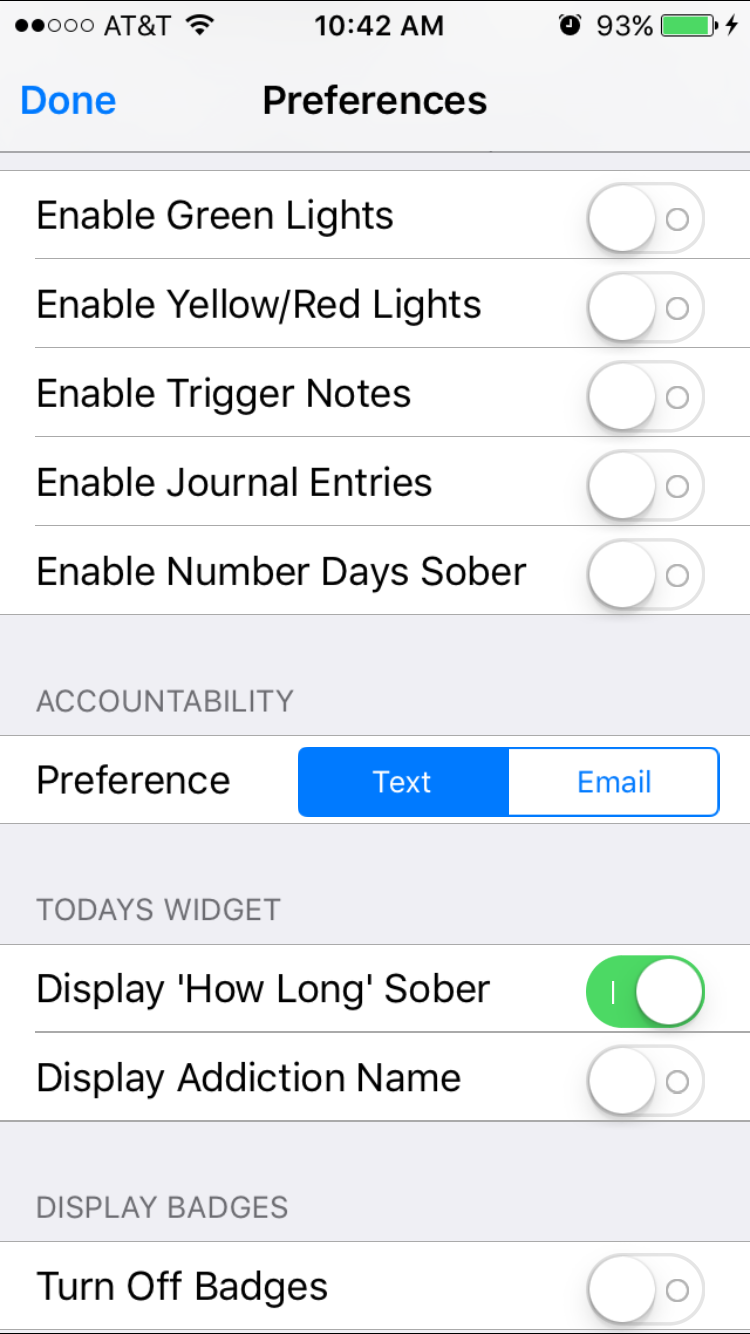
Select the preference tab to configure the Todays Widget


Turning on addiction labels will display the name rather than a motivational phrase.


Don't want to see length of sobriety and only want to see the reminder lights and accountability icons?  No problem.  Just turn it off an only see a motivational phrase.


Badge PopUp Configuration

Well, not everyone likes to have their badges popup in realtime as they earn them -- so you can now configure this too using the preferences for recoveryBox. If you turn off Display Badges they will stop popping up.  Its that simple!....but know that you are still earning your badges behind the scenes and anytime you want to go see what they are just visit the badge screen.

That's it for new features in 5.2!  Remember, if you have an idea let us know so we can see if it makes sense to add it in.  We want to support our users!


Friday, June 3, 2016

Part 3 : One to One Accountability and Your Sponsor

This is where the the entire concept for recoveryBox comes together. You have been diligent about entering your Lights and Triggers and now...

It's time to be honest with someone other than yourself.  And that's why you have a sponsor or accountability partner from a traditional 12 Step Program or from Celebrate Recovery.

When you send a text/email to your accountability partner, it will tally all of the Green, Yellow and Red lights.  You select the time frame (when I write more about the accountability module I'll explain how the dates default).

This is what's so awesome..there is no remembering what the day or week looked like because you already did the work when you entered the lights!!  And believe me it is work being honest to yourself.  

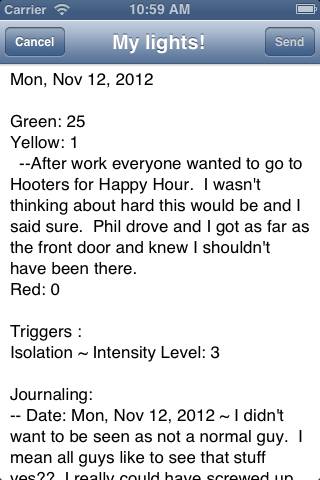
As you can see I use recoveryBox to text (as that's the default I set up) each day by 10:00PM.   It really is that simple and my sponsor can see  as a snapshot what my day looked like.  Let's see an example of what the system builds as a started text/email ( I can edit the piece of communication if I want before I send it too).

As you can see it puts the date (and in my case it's just the one date otherwise it's the range of dates I selected). Then it puts a total of my lights broken down by color...My sponsor and I have made a Green target number I'm supposed to hit and it changes as I meet my goals.

The Yellows and Red's are the hardest for me but it's where I'm being completely honest with myself and another.  Under the settings panel I've enabled comments to be added to my communication piece.  I have nothing to hide from my sponsor but it's nice to have the option (again, when I write more about that module, I'll show you how to enable those).

If I entered any triggers for the day, anything over a green level is included as well as my journaling.  I love being able to communicate to my sponsor without having to retype anything..yet I have it all recorded for me.  Sometimes my sponsor sees something that he is concerned about and will either call or text me back right away..but most times I just get a response saying "OK".  And that's all I need.

This part of recoveryBox is what really allows communication and knowledge to happen between my sponsor and myself.  BUT I do use this with my counselor too.  Sometimes I'm asked how the week was and it's so easy to pull up the information any way I want.  And I'm much more accurate because I can't say "I forgot".

Being successful in Addiction Recovery is about making changes.  With recoveryBox you can actually quantify the changes ~ and that's a good thing!

Use recoveryBox now for your Addiction Recovery.


Thursday, May 26, 2016

3 R's ~ Staying Motivated or Risk A Relapse

Random Resource ThuRsday!! 

3 R's ~ Staying Motivated or Risk A Relapse


I know from experience how easy it is to start down the road to recovery feeling the high of finally being free from a horrible secret and thinking I've got this licked!!  And then wham!!!  Something in life hits us and we run back to old habits, acting out and then going into relapse. 

And from there it is such a downward spiral.  Does anyone else know what I'm talking about here?!?

But that's why programs like a 12 Step Program or Celebrate Recovery have accountability partners as part of the approach.  Most of us just can't do this alone!  And we need someone to help us, encourage us, support us and motivate us.

This week I blogged about the Motivator piece of the recoveryBox iPhone Addiction Recovery App.  There is a good reason that is part of the app..it's to help us stay motivated.  Part of us as a person wants to please people other people.  It's part of being connected in life.  So when using a tool such as recoveryBox, it's important to stay motivated for compliance...because that IS one of the biggest pieces to addiction recovery.  You can't "cheat" here and there.  True recovery is to not return to those habits.

While doing research for recoveryBox, I ran across this article about motivation and it helped me focus on how can recoveryBox app can be part of that motivation.  Thanks Peggy for authoring such a great piece and for really just putting it out there in honest terms. 

(look for another blog post in a few weeks about another feature to recoveryBox that is all about motivation.  It's my favorite piece too!)


Addiction Recovery

Maintain Your Recovery Motivation Or You Will Relapse By Peggy L. Ferguson, Ph.D.


People often find their way to recovery in the midst of a crisis. Someone standing at the crossroads of recovery, may have been arrested for DUI, may have been fired, or may have received a scary report from the doctor. He may have heard the bottom line demand from his spouse-- "Get help or we are getting a divorce." Or, the alcoholic/addict may in fact, have a moment of clarity and really be able to see that he does have a problem and that help and abstinence are called for. The alcoholic/addict feels afraid. He feels ashamed. He feels angry at others or at himself for being in this position in the first place.

Fear, coercion or crisis helps him find his way into recovery. Fear is a fairly good short term motivator, but not so good in the long run. Once the fear subsides and the crisis is over, it is very easy to lose your motivation and momentum. At the point where the cycle of addiction is interrupted by failing to take the next drink, dose, or joint, there is a lot of tension, anxiety, and mindfulness of where you are in the process. Detox or withdrawal may occur, with physical and/or emotional symptoms being very consciously experienced.

When you get to feeling better physically and emotionally after detoxing, it is easy to lose your momentum. Your focus on recovery can dissolve. Some of the problems that once motivated your recovery might be resolved now. Because you have quit drinking or using, your spouse and kids are once again speaking to you and are in the process of forgiving you. You may have even won back some trust. Everything seems to be going well.

Under these circumstances it is quite easy for you to take your eyes off the target and lose your focus on recovery. Erroneously, you may believe that your abstinence is not so fragile now. Feeling better, you may think you have it "whipped".

Without actively focusing on your continuing abstinence and recovery, your behavior can begin to drift away from the newly instituted behavioral changes that you have made. You run the risk of returning to old thinking, old feelings, and then ultimately old behavior. The reason why this would happen is that you are not consciously taking steps to continue on a path of recovery. This path involves many changes in your behavior and in your life style. Without making conscious choices in regard to how each decision affects your new recovery life or your old addiction life, you are unconsciously choosing your old life. Choosing recovery is not like jump starting your damaged car battery where once you get it started, it recharges itself as run it. You have to continuously work a program of recovery. Without doing so, your efforts will be short- lived.

You will quit going to counseling. You will quit going to meetings. You will have stopped calling your recovery support people. Your defenses will go back up and you may take exception to the feedback of significant others who tell you that you are acting like you used to before recovery.

You won't be able to see that you are on the road to relapse. You won't be able to understand why they are concerned. You won't be able to identify the behavioral changes that scare them because you will be back in denial. Being around old drinking/using environments and friends don't scare you. You can't understand why it would scare your significant others. After all, you told them that you are not going to relapse. You have learned your lesson. What more do they want?

After awhile, you will begin to think that you have your drinking or using under control now. When you think of addiction as a thing of the past, that you now have it under control, you will begin to entertain the notion that you can now drink or use without negative consequences. If any of this sounds like your recent experience, you are in big trouble. You are in the relapse process and unless you do something now, you will relapse--and soon.

Copyright 2009, Peggy L. Ferguson, Ph.D., http://www.peggyferguson.com Hubbard House Publishing, Stillwater, OK. 

Download recoveryBox, Addiction Recovery App - Your Complete Sobriety Toolbox

Wednesday, May 25, 2016

Random Resource ThuRsday - So I shouldn't Go "There". Now What?

This week I wrote about how just being at a location is dangerous to the undoing of our sobriety. I found a wonderful resource that talks about this and a lot more.  In this document are tons on strategies to fight the addiction.  Take a look.

For more from this recovery website, visit http://www.markhoustonrecovery.com.

Below is the section from the resource that deals with Being at the Place (the Y2) and strategies.
I am glad the author put this trigger at the top of the list.  It's why I have the Person of Risk as the Y1 and the Place as the Y2 Yellow Lights.  Warning!!  Warning!!  Use Caution here!

Relapse Trigger #1: Putting Yourself In Difficult Situations Like Visiting Your Favorite Bar Or Hanging Out With Friends Who Are Still Using


Perhaps the most difficult part of recovery is leaving behind old friends or old habits that got us into trouble in the first place. Even if we are committed to staying away from your previous group of friends or hangouts, if we don’t change our habits and interests, we can quickly find yourself with a new group of friends or hangout spots that are just as damaging to our recovery process.
Relapse Prevention Action Plan:
  • Find alternative places to hang out like a local bookstore or coffee shop.
  • Choose companions who seek a healthy lifestyle.
  • Go to a recovery based meeting. 
I really do encourage you to read the rest of the pdf file.  It is loaded with strategies to help in your addiction recovery.

To download recoveryBox,visit the Apple App Store.

Monday, May 23, 2016

The Serenity Prayer ~ the history behind it


I was curious about the history behind this beautiful prayer and did a little research. Read below or click this link for the article.
---------------------------------------------------------------------------------------------------
The Serenity Prayer is the common name for an untitled prayer originally written by theologian Reinhold Niebuhr in the late1930s to early 1940s. It is believed that Niebuhr wrote the prayer for a sermon.
Elisabeth Sifton's book entitled The Serenity Prayer, which was published in 2003,,quotes this version as the authentic original:
"God, give us grace to accept with serenity the things that cannot be changed, courage to change the things that should be changed, and the wisdom to distinguish the one from the other."
The earliest verifiable texts so far discovered are an approximate version, apparently quoted from memory, in a query in the in The New York Times Book Review dated July 12, 1942 which asks for the author of the quotation; a reply in the same column issued on August 2, 1942 states the quotation is attributed to Niebuhr and an unidentified printed text is quoted as follows:
"O God and Heavenly Father,
Grant to us the serenity of mind to accept that which cannot be changed; the courage to change that which can be changed, and the wisdom to know the one from the other, through Jesus Christ our Lord, Amen."
The serenity prayer became widely known when it was adopted by Alcoholics Anonymous; In 1950, the AA Grapevine, an AA magazine, identified Niebuhr as the author and the current AA web site continues to identify Niebuhr as the author.
The serenity prayer is reported to have been in use in Alcoholics Anonymous since the early 1940s. It has also been used in Narcotics Anonymous and other Twelve-step programs.. The Alcoholics Anonymous version of the serenity prayer omits some of Niebuhr's text:
"God grant me the serenity to accept the things I cannot change,
courage to change the things I can,
and (the) wisdom to know the difference."
Niebuhr discusses the Serenity Prayer and how it came about it in his book, The Essential Reinhold Niebuhr: Selected Essays and Addresses. He states,
"... The embarrassment, particularly, was occasioned by the incessant correspondence about a prayer I had composed years before, which the old Federal Council of Churches had used and which later was printed on small cards to give to soldiers. Subsequently Alcoholics Anonymous adopted it as its official prayer. The prayer reads: 'God, give us grace to accept with serenity the things that cannot be changed, courage to change the things that should be changed, and the wisdom to dintinguish the one from the other.' ..."
In addition, Niebuhr's daughter, Elisabeth Sifton, wrote an entire book about her father's serenity prayer, The Serenity Prayer: Faith and Politics in Times of Peace and War, that explores the circumstances around which her father wrote this prayer, the wide range of versions of this prayer, and the real essence of the prayer's meaning.

Article Source: http://EzineArticles.com/552531

Wednesday, May 18, 2016

Why Is It So Damn Hard to Change?


Random Resource ThuRsday

This week I blogged about knowing the what's and why's that lead to your acting out.. and that you have to have data to understand your habits. Knowing your triggers is key to breaking an addiction.   When we act on our triggers, we are just reinforcing our trigger/behavior/reaction mechanism. 

Oprah is not where I normally get information for sharing but I thought this was a great article that talks about dopamine ..  you know the chemical released in your body when you do an acting-out behavior.  I cropped out a small portion for you to read but I urge you to read the rest.


Why Is It So Damn Hard to Change?


Read more: http://www.oprah.com/health/How-to-Change-Your-Bad-Habits/3#ixzz2MsAonyaW

Photo: Hugh Kretschmer
Dopamine teaches your brain what you want, then drives you to get it, regardless of what's good for you. It does this in two steps. First you experience something that gives you pleasure (say, McDonald's french fries), which causes a dopamine surge. Some of that dopamine travels to the area of your brain where memories are formed and creates a memory connecting those fries with getting a reward. At that point, in sciencespeak, the fries have become "salient." And when you're exposed to something that's salient, you may think, "That's bad for me, I shouldn't,"  but your brain registers, "Dopamine jackpot!" 

Which is where step two comes in: On top of creating memories, dopamine controls the areas of the brain responsible for desire, decision-making, and motivation. So once fries become salient, the next time you see or smell them, your brain releases a surge of dopamine that drives you to get more fries. When you succeed, your brain produces more dopamine, which reinforces the memory that made fries salient in the first place, etching it further into your brain. It's a never-ending cycle: The more you do something that's rewarding, the more dopamine makes sure you do it again. This is precisely how habits form. Eventually, if the fries become salient enough, your brain will release dopamine and push you to get fries anytime you see the colors yellow and red, even if you're nowhere near McDonald's.

And this is true for any behavior that results in a reward: Orgasms cause dopamine surges. So does hitting the jackpot when you gamble, winning a race, acing a test, doing cocaine or methamphetamines, smoking, drinking. "Dopamine is motivation," 

...

But my big question for Volkow is this: How do you get yourself hooked on something that's not inherently pleasurable to you—like living on salads and broccoli or, in my case, exercising? Many people get a natural high from working out. I, however, am not one of them. "Isn't there some way to trick the dopamine system?" I ask her. "Some way to fool my brain into craving exercise?"

Sure, she says: The secret is thinking up rewards. My payoff for working out could be a pedicure or a new pair of shoes. For someone trying to diet: Maybe you get a massage after a week of good eating, or have a friend dole out gift certificates if you stay on track (you pay, but she controls the vouchers). "Giving yourself rewards for a behavior engages the dopamine system so your brain will associate the positive outcome with it, which will help you form the habit."

Read more: http://www.oprah.com/health/How-to-Change-Your-Bad-Habits/2#ixzz2MsAgxKuM


Well, I wish I could reward all the recoveryBox users with something great to help retrain our brains..but hopefully when you earn your badges, that will give you a small sense of accomplishment.

For more information about recoveryBox, visit the website and see if it's an app that might be helpful in your recovery from your addiction. www.recoveryboxapp.com